
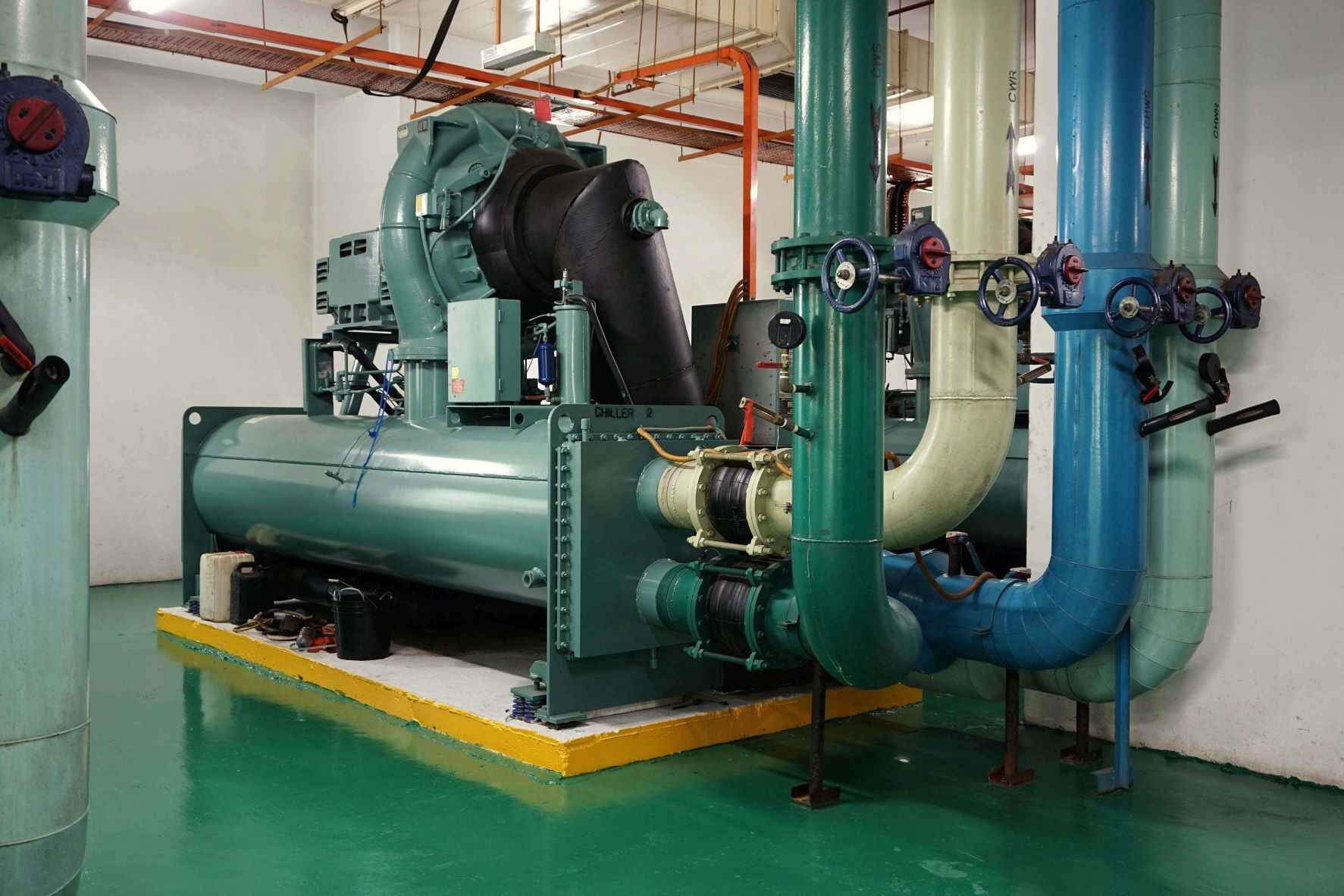
Central Chiller Plant Replacement, Acute-Care Hospital
Two 800-ton chillers, towers, primary/secondary pumping and plant controls replaced across two summers without a single loss of cooling to the surgical tower.
- Plant capacity
- 1,600 tons
- Duration
- Two phased summers
- Cooling interruptions
- Zero to critical areas
- Delivery
- Design-build
What made it hard
The plant served the surgical tower, imaging, sterile processing and two patient towers off a single common header with no isolation between machines. The original 1980s chillers were failing on refrigerant leaks, one tower structure was corroded past repair, and the pneumatic-era plant controls staged equipment so poorly that both chillers frequently ran at part load in mild weather.
The hospital could not lose chilled water to critical areas at any point — not for an hour. There was also no laydown space; the plant was in a basement with a single equipment hatch sized for the original machines, not modern ones.
How we executed it
We phased the work across two summers, replacing one chiller and one tower per season. Before either machine came out, we installed new isolation valves and a temporary tie-in so the remaining chiller plus a rented 500-ton temporary unit could carry the building's critical load through each cutover.
New chillers were specified in a knock-down configuration and reassembled in the basement to clear the hatch. Header spools, pump bases and tower steel were fabricated in our shop and staged so field work was assembly rather than fitting. Plant controls were replaced in parallel with the existing system, with the new front end proven on the surviving chiller before the second phase.
Every cutover happened on a Friday night into Sunday, with facilities staff and our foreman monitoring chilled water supply temperature and critical area conditions continuously, and a written rollback plan for each one.
What the owner got
Both phases completed within their scheduled windows with no interruption of chilled water to surgery, imaging or sterile processing.
Plant staging and chilled water reset sequences cut plant energy consumption substantially versus the prior control strategy, and the hospital gained the ability to isolate either machine for service without shutting the loop down — something the original plant never had.
CMI has held the maintenance agreement on the plant since turnover.



Bring us the hard one
Occupied buildings, no shutdown window, a survey finding with a deadline, a plant nobody wants to touch. That is the work we are built for.