
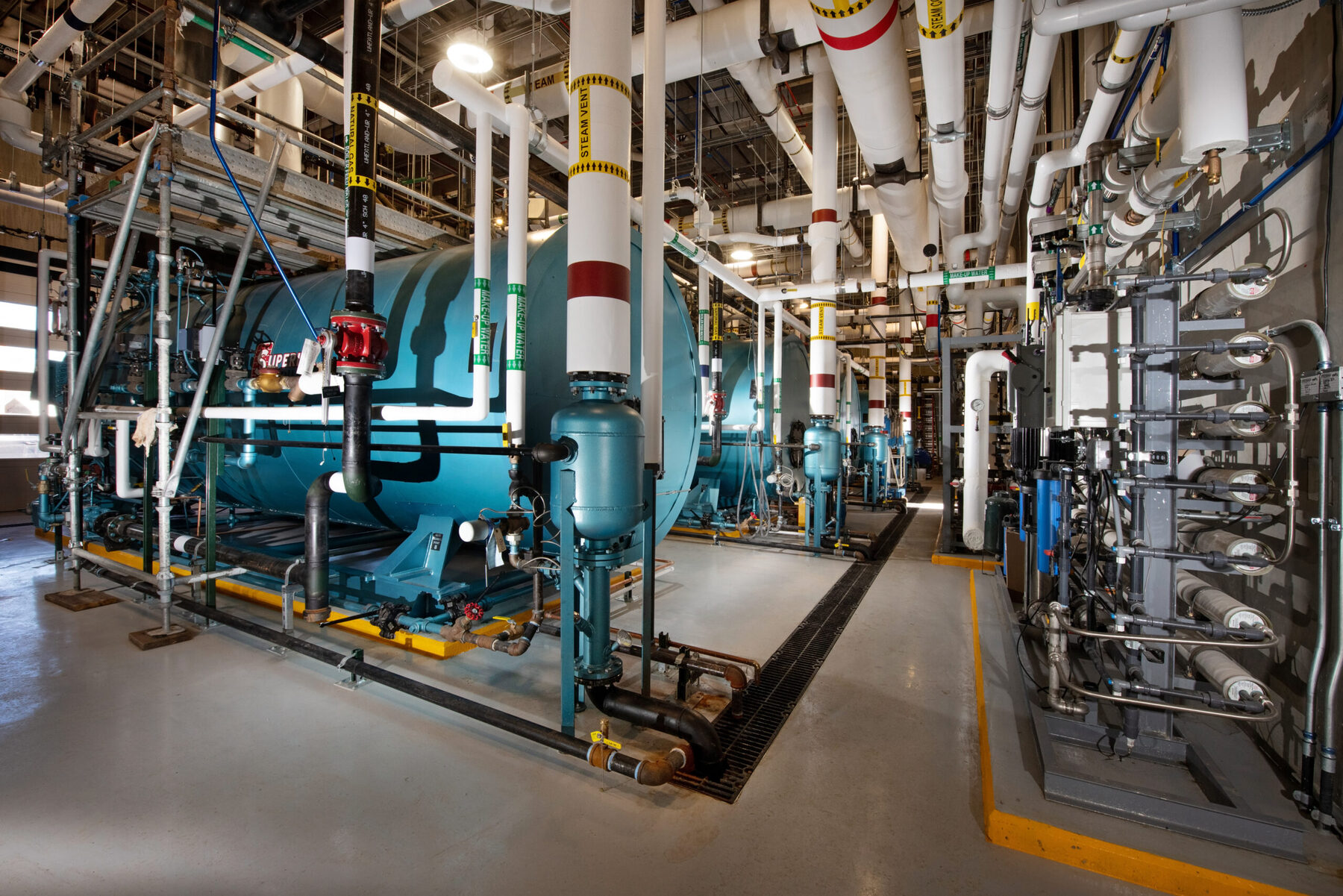
Steam Systems & Steam Trap Surveys
Trap surveys, PRV stations, separators and condensate systems — steam expertise most HVAC contractors no longer have.
Steam is the trade most mechanical contractors have quietly dropped, and it is one of the reasons hospitals call us. Sterilizers, humidification, kitchen and laundry equipment, domestic hot water and heating all depend on a distribution system that is decades old, buried in tunnels and mostly undocumented.
We service the whole system: pressure reducing valve stations, safety relief valves, separators and drip legs, steam traps, condensate receivers and pumps, deaerators, flash tanks, heat exchangers and converters, insulation, and the piping itself. Failures get diagnosed by measurement — ultrasonic and thermal trap testing, pressure logging, condensate temperature and flow — not by guesswork.
Steam trap surveys are a standing program for our institutional customers. Every trap is tagged, located, tested and reported with condition, estimated steam loss and dollar impact; failed traps are replaced with the correct type and size. On a large hospital campus the first survey typically finds 15–30% of traps failed, and the recovered fuel pays for the program several times over.
Scope & capabilities
- Full steam trap surveys with tagging, testing, loss estimates and replacement
- Safety and relief valve replacement, testing and certification support
- Steam-to-hot-water converters and shell-and-tube heat exchanger service
- Insulation replacement on steam and condensate distribution
- Ultrasonic and thermographic diagnostics with logged data
- Pressure reducing valve station rebuild and replacement
- Condensate receiver, pump, flash tank and deaerator repair and replacement
- Drip leg, separator, strainer and air vent corrections
- Steam distribution tunnel and vault inspection and repair
The technical envelope
- Pressures
- Low-pressure heating steam through 150 psi
- Survey output
- Tagged trap inventory, condition, steam loss and cost per trap
- Typical finding
- 15 – 30% trap failure rate on first survey
- Trap types
- Thermostatic, thermodynamic, F&T, inverted bucket, orifice
- Response
- 24/7 emergency for steam leaks and plant failures
Facility types
Steam Systems & Trap Surveys — straight answers
- How often should steam traps be surveyed?
- Annually for institutional and hospital systems, and on higher-pressure or critical branches more often. Traps fail continuously, and a failed open trap on 100 psi steam can waste thousands of dollars a year on its own.
- Can you work on our steam system while it stays in service?
- Much of it, yes — trap replacement, drip leg work and many valve repairs are done on isolated branches. Where the main has to come down, we plan the outage with your plant operators around sterilizer and laundry schedules.
- Do you handle steam tunnels and buried distribution?
- Yes, including confined-space entry procedures, insulation replacement, expansion joint and anchor repair, and leak location on direct-buried and tunnel systems.
Get a number you can budget against
We walk the plant before we price it. You get equipment condition, options, phasing and a schedule — not a guess with a contingency wrapped around it.